
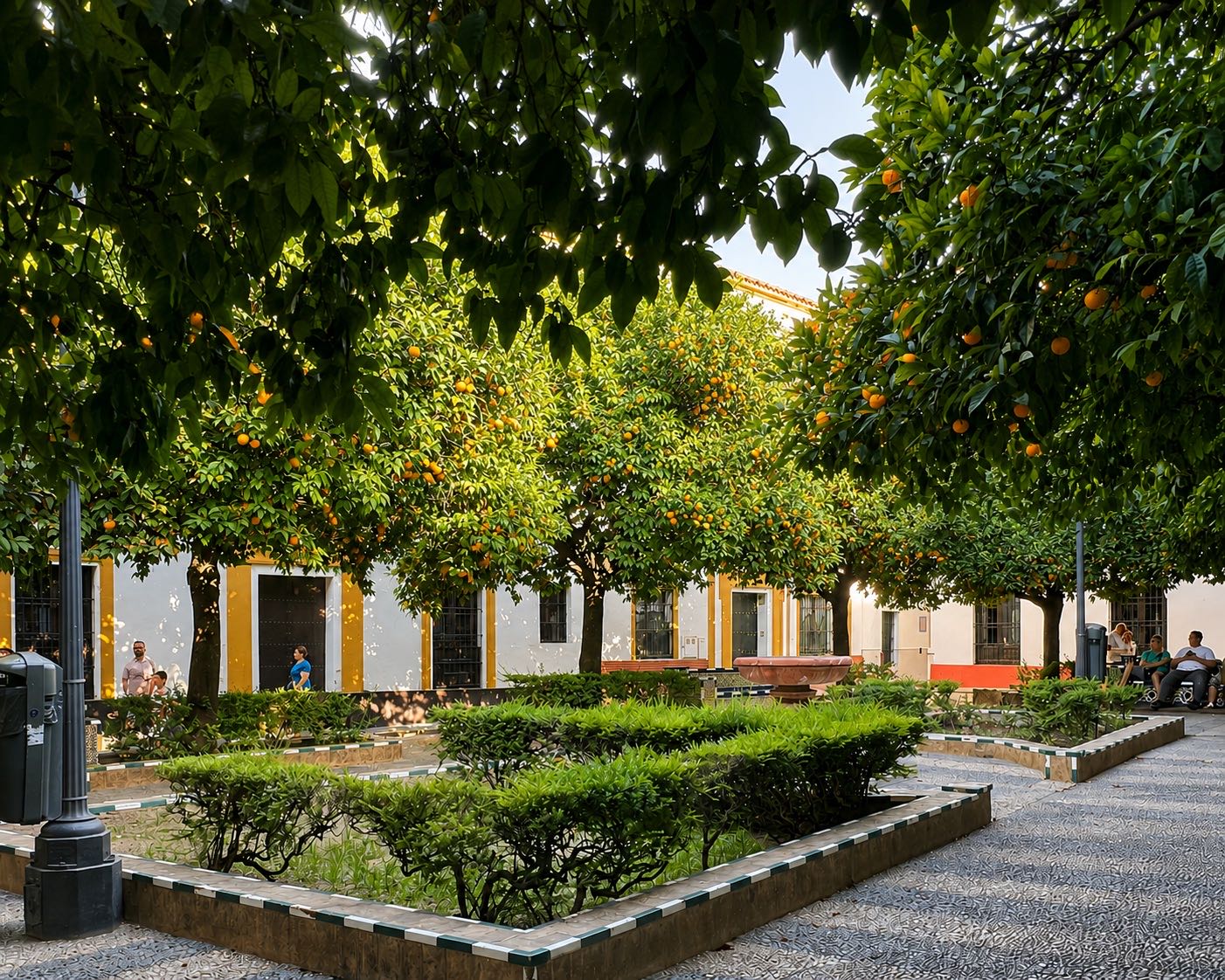
Santa Cruz is Seville's old Jewish quarter, known for narrow whitewashed streets, and free to explore. White houses with yellow trim, bougainvillea on every corner, the scent of orange blossom in the narrow streets. But the history behind this beautiful picture is far more fascinating than the postcards let on.
Designed for tourists — in 1929
Here comes the secret that surprises almost everyone: Santa Cruz as we see it today was largely designed and completed for Seville's world fair in 1929. The idea was to create something genuinely Andalusian — romantic, regionalist and visually overwhelming — precisely to attract visitors to Seville.
There's something fascinating and almost amusing about the thought: that someone in 1929 already had the tourist's eye. That they understood the white, the flowering, the labyrinthine would do something to people. And they were right — nearly a hundred years later it still feels exactly as powerful.
«Santa Cruz was designed to seduce visitors back in 1929. That it still feels just as perfect nearly a hundred years later says something about how well they succeeded.»

La Judería — what lay here before
Long before 1929, this quarter was known by another name: La Judería — the Jewish quarter. In the Middle Ages, Seville was home to one of the largest Jewish populations on the Iberian Peninsula, and this was their district — a dense, lively, pulsing heart of trade, learning and culture.
The history of La Judería is full of what makes history human and harrowing at once. Mosques were turned into synagogues. Synagogues were turned into churches. Families who had lived here for generations were expelled in 1391 and again in 1492 — when Fernando and Isabel decreed that the Jews must leave Spain. Some of the narrowest streets and enclosed patios of Santa Cruz still carry the echo of what once was.
Streets with dramatic names
One of the things I love most about walking through Santa Cruz is the street names. They aren't random — they tell stories, some romantic, some dark, some mysterious.
That the Street of Life and the Street of Death lie side by side in this maze is no coincidence. Santa Cruz is a district that has always held both — the beautiful and the tragic, the bright and the dark — as close to each other as the houses on the narrow streets.
Seville's highest point — and my Bergen perspective
I'm from Bergen — a city surrounded by tall mountains. Seville is known for being flat, and mostly it is. But right in the middle of the Santa Cruz quarter you'll actually find Seville's highest point: a small, seemingly completely ordinary street called Calle Aire — about 115 metres above sea level. No sign, no viewpoint, no tourist attractions.
«I come from Bergen with its tall mountains. Seville's highest point is a completely ordinary little street — Calle Aire — right in the middle of the maze. No sign, no view. Just a street like any other, 115 metres above sea level. That's so Santa Cruz.»
The maze that never gives you everything at once
Santa Cruz is one big maze — and that's the point. One turn too many, a corner you didn't notice — and suddenly you're somewhere entirely different from where you'd planned. Even though Santa Cruz has become more visited over the years, there are still places here where time has stood still. It takes a bit of patience and a bit of willingness to get lost — but it's always worth it.
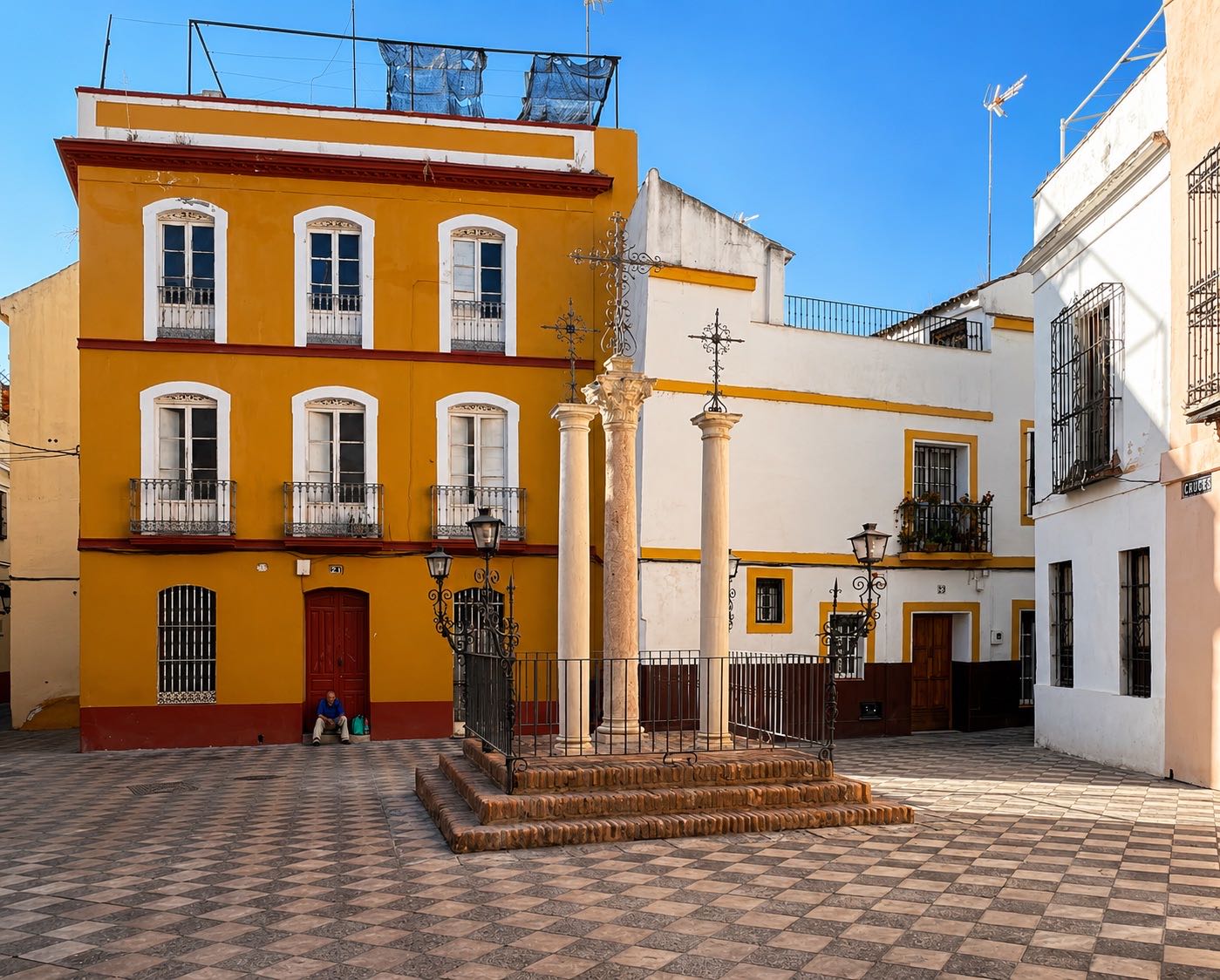
- Formerly La Judería — the historic Jewish quarter of Seville
- Today's appearance largely designed for the 1929 world fair
- Seville's highest point lies right in the district — approx. 115m above sea level
- Streets named Calle del Agua, Calle de la Muerte and Calle de la Vida
- Freely accessible — no ticket needed
- Best time to visit: afternoon or during siesta hours
Frequently asked questions
Santa Cruz was formerly La Judería, the historic Jewish quarter of Seville.
No, the district is freely accessible and requires no ticket.
Afternoon or during siesta hours, when the streets are calmest and the atmosphere most authentic.